
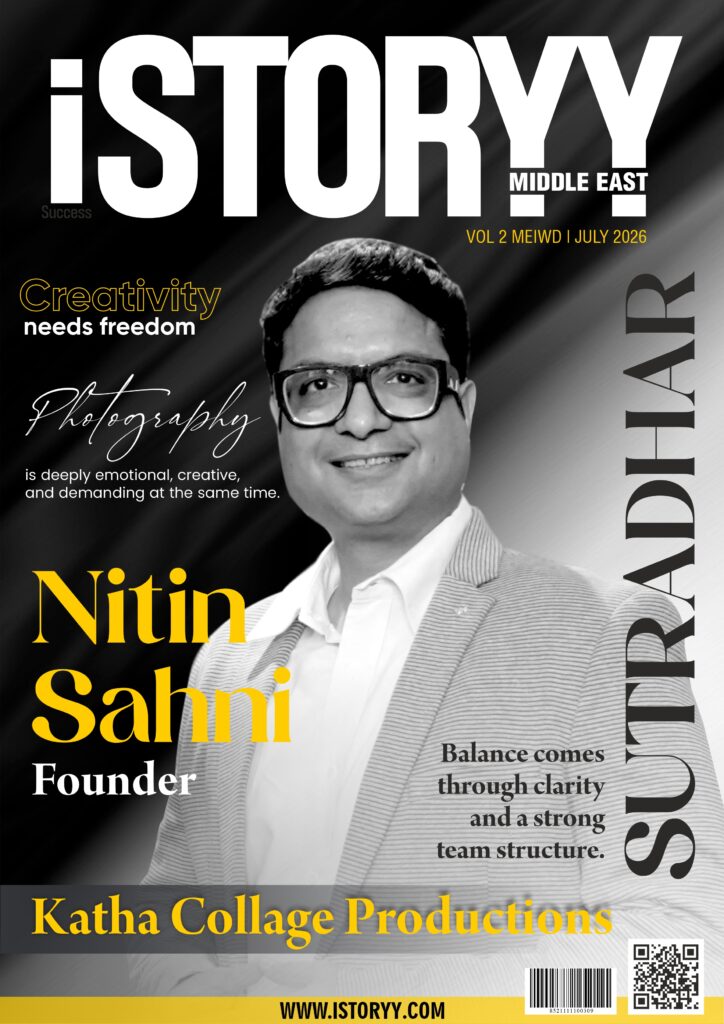
Nitin Sahni
Founder and Sutradhar
Katha Collage Productions
Q1. Can you walk us through your journey from your early days to becoming the founder of
Katha Collage?
My journey started with a simple fascination for stories and emotions. I always believed that photographs are not just images; they are memories frozen in time. Initially, photography was more of a passion than a profession, but gradually I realized that visual storytelling had the power to connect people deeply. In 2015, I founded Katha Collage. Productions with the vision of creating meaningful narratives through photography and films, especially in the wedding space where emotions are most raw and beautiful. Over the years, what started as a small creative dream has grown into a brand that works across India and internationally.
Q2. What inspired you to step into the photography?
The inspiration came from observing how moments pass but emotions remain. I was drawn towards the ability of photography and films to preserve feelings, relationships, and human connections forever. At the same time, the media-tech space was evolving rapidly, and I wanted to blend creativity with innovation. I saw an opportunity to create cinematic storytelling with modern technology while still keeping emotions at the center of every project.
Q3. With over so many years of experience, how has your leadership style evolved?
In the early years, I believed leadership was about managing everything personally. But with experience, I learned that true leadership is about building trust, empowering your team, and allowing creativity to flourish. Today, my approach is more collaborative and people-focused. I believe every team member brings a unique perspective, and great work happens when everyone feels valued and inspired.
Q4. How has your role as a Founder of Katha Collage influenced your approach as a
business leader?
Being the founder taught me resilience, adaptability, and patience. Creative businesses are not only about art; they are also about consistency, relationships, and delivering experiences. Over time, I understood that being a business leader means balancing vision with execution. It also taught me the importance of evolving continuously while staying authentic to our identity.
Q5. How do you manage to balance the creative and operational aspects of your
organisation?
Balance comes through clarity and a strong team structure. Creativity needs freedom, while operations need discipline. I try to divide my focus strategically — giving creative direction where storytelling matters most while ensuring systems and processes are streamlined in the background. Over the years, I’ve also learned the importance of delegation and trusting capable people around me.
Q6. What barriers did you face as a Creativepreneur , and how did you overcome them?
One of the biggest challenges was establishing originality in an industry that is highly competitive and trend-driven. Initially, there were limitations in resources, technology access, and even client awareness regarding cinematic storytelling. But consistency helped us grow. We focused on building genuine client relationships, improving our craft continuously, and adapting to new technologies without losing our emotional storytelling style.
Q7. What advice would you give to new people aspiring to enter photography ?
Never enter this field only because it looks glamorous. Photography is deeply emotional, creative, and demanding at the same time. Learn patience, understand human emotions, and focus on storytelling rather than just equipment. Technology will keep changing, but your perspective and authenticity will always define your work. Also, stay humble and never stop learning.
Q8. If you had to summarize your philosophy in one sentence, what would it be?
“Every frame should not just capture a moment, but also preserve the emotion behind it.”
Q9. What legacy do you hope to leave in the world of photography, specially wedding
photography?
I want Katha Collage to be remembered not just for beautiful visuals, but for meaningful storytelling. Weddings are not only events; they are family histories, emotions, traditions, and relationships coming together. If our work can make people relive those emotions even decades later, that would be the most fulfilling legacy for me.