
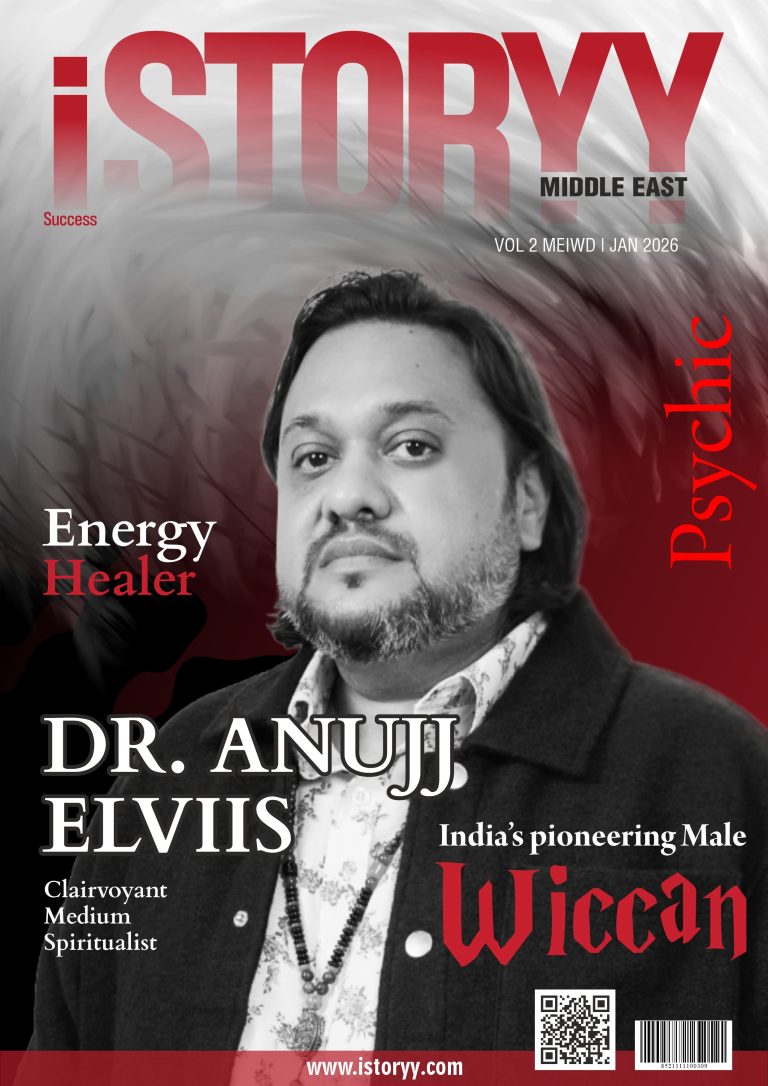
Dr. Anujj Elviis
India’s pioneering Spiritual Psychologist |Wiccan | Psychic | Clairvoyant | Medium and Energy healer
Q1. How did your childhood illness awaken your spiritual path?
My illness stripped away the illusion of control very early in life. When the body is fragile, awareness turns inward. In that quiet vulnerability, I began sensing layers of reality that most people don’t notice because they are distracted by survival and ambition. What began as suffering became initiation. It taught me listening—first to my body, then to energy, and eventually to spirit. I didn’t seek the occult; it revealed itself as a language of survival and understanding.
Q2. Seeing spirits as a teenager—how did you emotionally process it?
At first, with fear and isolation. When a gift is not named or validated, it feels like a burden. I learned early that silence can be safer than explanation. Over time, psychology helped me ground what spirituality revealed. I learned discernment—what belongs to imagination, what belongs to intuition, and what requires boundaries.
Emotional maturity came from learning that not every experience needs interpretation, and not every vision needs to be shared.
Q3. What made you embrace your calling instead of resisting it?
Resistance came from wanting to be “normal.” Acceptance came from realizing that denial was costing me peace. The moment I stopped asking why me and started asking how do I serve responsibly, everything shifted. A calling is not about power—it’s about stewardship. Once I understood that, resistance dissolved.
Q4. What did cemeteries teach you about life, death, and fear?
Cemeteries taught me that death is not frightening—ignorance is. They are spaces of stillness, not horror. Sitting among the dead stripped fear of its drama and revealed death as transition, not punishment. Ironically, those spaces taught me how precious and temporary life truly is—and how ego dissolves when faced with silence.
Q5. How do you explain Wicca to an Indian audience?
I explain Wicca not as a foreign religion, but as a philosophy Indians already understand. Nature reverence, cyclical time, elemental balance—these are deeply Indic concepts. Wicca is not devil worship or superstition. It is ethical, earth- based spirituality rooted in responsibility, consent, and harmony. The misunderstanding comes from colonial narratives and fear, not from truth.
Q6. How do your three principles shape daily life?
Knowledge of self creates awareness.
Power over self creates discipline.
Control over self creates freedom.
These principles manifest in daily choices—how one reacts, speaks, spends energy, and treats others. Without self-mastery, spirituality becomes fantasy. With it, spirituality becomes embodied wisdom.
Q7. Why has society grown disconnected from occult traditions?
Because modern society values speed over depth. Occult sciences require patience, humility, and inner work—qualities that don’t sell well in a culture addicted to
shortcuts and spectacle. Add misinformation and fear-based narratives, and ancient wisdom becomes misunderstood instead of explored.
Q8. How can seekers identify genuine practitioners?
A genuine practitioner empowers you; a fake one makes you dependent. True spiritual work encourages accountability, emotional growth, and clarity—not fear, urgency, or financial pressure. Ethics, consistency, and transparency are far more important than claims of power.
Q9. How do you blend multiple systems without dilution?
I don’t blend systems—I contextualize them. Each practice has its own structure, ethics, and purpose. Integration happens at the level of intention, not ritual confusion. Respecting boundaries preserves potency. Mastery comes from depth, not accumulation.
Q10. An experience that validated “Divine working through a person”?
Watching a student heal—not just physically, but psychologically—without dependence on me. When transformation continues after the practitioner steps away, you know the Divine was the source, not the ego. That is the true validation.
Q11. What personal cost has visibility demanded?
Privacy. Safety. Misrepresentation. Visibility invites projection—both reverence and hostility. Being India’s first openly male Wiccan meant enduring ridicule, threats, and distortion. But silence would have been a greater betrayal—to myself and to others searching for truth without fear.
Q12. Responsibility in a society that harms people over witchcraft accusations?
Immense responsibility. Practitioners must educate, not sensationalise. We must reject fear-based narratives and actively dismantle myths that lead to violence. Silence in such a context is complicity.
Q13. How can one discover their true spiritual self?
By slowing down.
By questioning inherited beliefs.
By cultivating self-honesty before seeking guidance.
Spiritual awakening is less about acquiring power and more about removing noise.
Q14. The most dangerous myth about occult sciences?
That they bypass accountability. There is no spiritual shortcut that exempts one from ethics, psychology, or consequences. The occult is not escape—it is responsibility magnified.
Q15. What legacy do you hope to leave?
A legacy of discernment. Where spirituality is intelligent, compassionate, ethical, and grounded. If future practitioners are less fearful, more informed, and more humane because of my work—that will be enough.
Important Links
- Visit Website
- Email anujjelviis@gmail.com
- Phone No +91-9911830425