
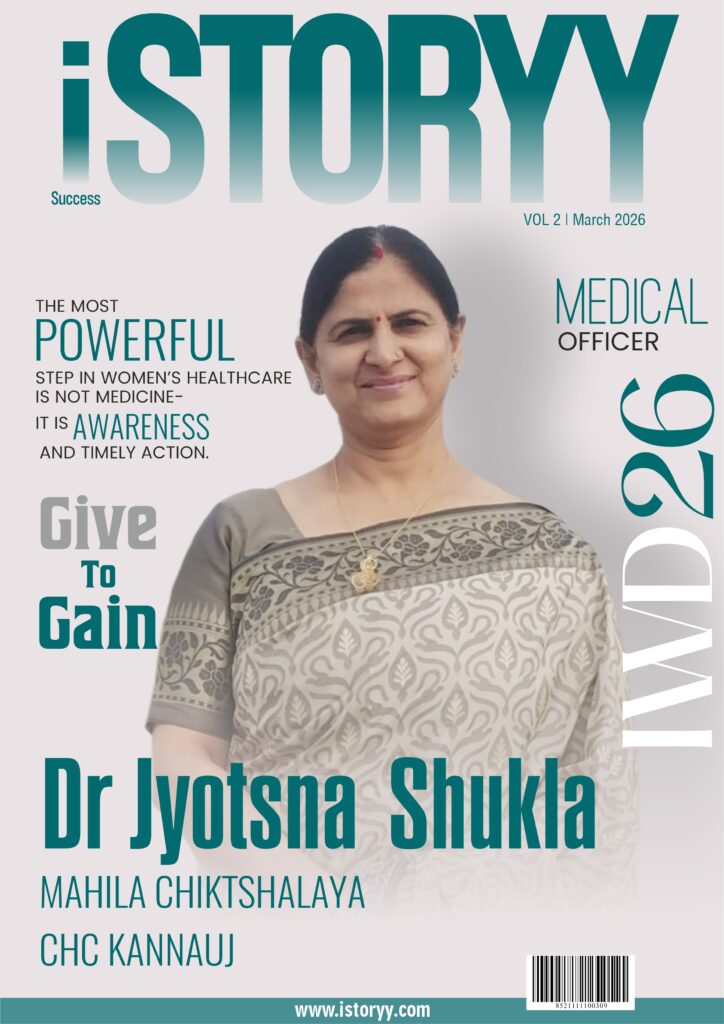
Dr Jyotsna Shukla
Medical Officer | Mahila Chikitshalaya |
CHC Kannauj
Q1. Let’s begin at the beginning — what inspired you to choose
medicine as your career, and how did your journey unfold
from a student to becoming a Medical Officer?
I was inspired and motivated by mother who wish to make her children specially the female as educated as possible though she came from small village this let me to choose medical profession. My journey begins working with NGO (Gramodaya Sansthan) under project on Prevention of child-labour at District Kanpur. This gave me opportunity to understands the issue related to health and sanitation in the slums of Kanpur which leads to number of health-relatedissues to them. Subsequently another opportunity came in for working with DUDA (District Urban Development Authority) where different health camps were organized in slums area of Kanpur. I also worked with my own clinic and some local hospitals at Kanpur & this altogether gave me an overall insight about health-related challenges of the slums and common people of society and this enriched my knowledge with real practical approach for common people. After that, I got married in 1999 and came to Kannauj and started my similar journey in a private hospital and with all this background I got to chance to get selected as Medical Officer in Govt. Hospital at Kannauj.
Q2. Was there a defining moment during your medical education
or early practice that shaped your decision to serve in
women’s healthcare?
During my journey of education and initial practice where I serve slums and interacted with children, women and common men altogether. I realized if the health-related issue for women is taken care the issue of her children would automatically vanish to good extend and she will in position to take care of home and this will lead to health of common men too. This made me feel that of health in Indian society is health of women and this led me to this decision.
Q3. As a Medical Officer at Mahila Chikitshalaya, what does a
typical day look like for you? What are the most common
health concerns you see among women in Kannauj?
Normally in a day, I do meet more than 100 patients at hospital. Most of the patients are coming for anti natal checkup (ANC) pregnancy, menstrual disorders and family
planning and other infectious diseases. The concern I feel is awareness about hygiene and counselling for family planning and also about awareness Govt. support systems and schemes for their health.
Q4. Working in a government hospital often comes with unique
challenges. What have been some of the toughest situations
you’ve faced, and how did you overcome them?
Working in a Govt. hospital a lot of unique challenges where expectation of the peoples is too high and in numbers of cases, we could not go certain limits because there is a system and a structure of work prevail. To overcome this often discuss with our seniors and refer to higher centers.
Q5. Women’s health in smaller cities and rural areas still faces
many social and cultural barriers. What changes have you
personally witnessed over the years?
Women in smaller cities and rural area, are not well educated and they are unaware about hygiene aspects, for numbers of health issues they do have certain myths and taboos. They have seen and learn from society and family, for example the birth of child given by God only. They don’t believe in family planning. They think “Bacche Bhagwan ki Den Hai”.
Q6. Is there a particular patient story or experience that deeply
touched you and reaffirmed your purpose as a doctor?
There is not specific story, there is series of stories they are common to me for example number of patients keep waiting even if I am not available in hospital either for them or for their relatives. They will not consult another doctor. Sometimes they do come from metro cities to show and discuss their issue with me. They do discuss personal and health issue together with me. They come with children and newly born baby and get my blessing though more qualified doctor are available in those metro cities, but I feel more about personal relationship between patients and doctor for to heal them more than medicine.
Q7. Preventive healthcare is gaining importance today. What are
the top three health awareness messages you would like
every woman to understand?
The top three health awareness messages are
a) A Healthy family starts with Healthy mother
b) Prevention is better than late cure.
c) Every birth should happen in hospital.
Q8. How do you balance the emotional demands of being a doctor
with your personal life? What keeps you motivated during
difficult days?
The long-term vision is to continue working for women healthcare, as I believe a healthy women would make a healthy nation and to pursue this, I visualize using on NGO I
make to plan start for set purpose it exists online and offline both.
Q9. If you could bring one major reform or initiative to improve
women’s healthcare in Kannauj, what would it be?
To be a doctor and to meet my patient and serve them is my passion and taking care of my family is my happiness and energy for me to take care my passion that is the replan I did not reopen my hospital at Kannauj which I had in Kanpur.
Q10. Looking ahead, what is your long-term vision — both for
your personal growth as a medical professional and for the
future of women’s healthcare in India?
To improve women health are it needs literacy and awareness women and girls and this I do via Inner Wheel Club where I have been President three times and we at Inner Wheel keeps on doing awareness and health related programme apart from what is being done by medical officer.