
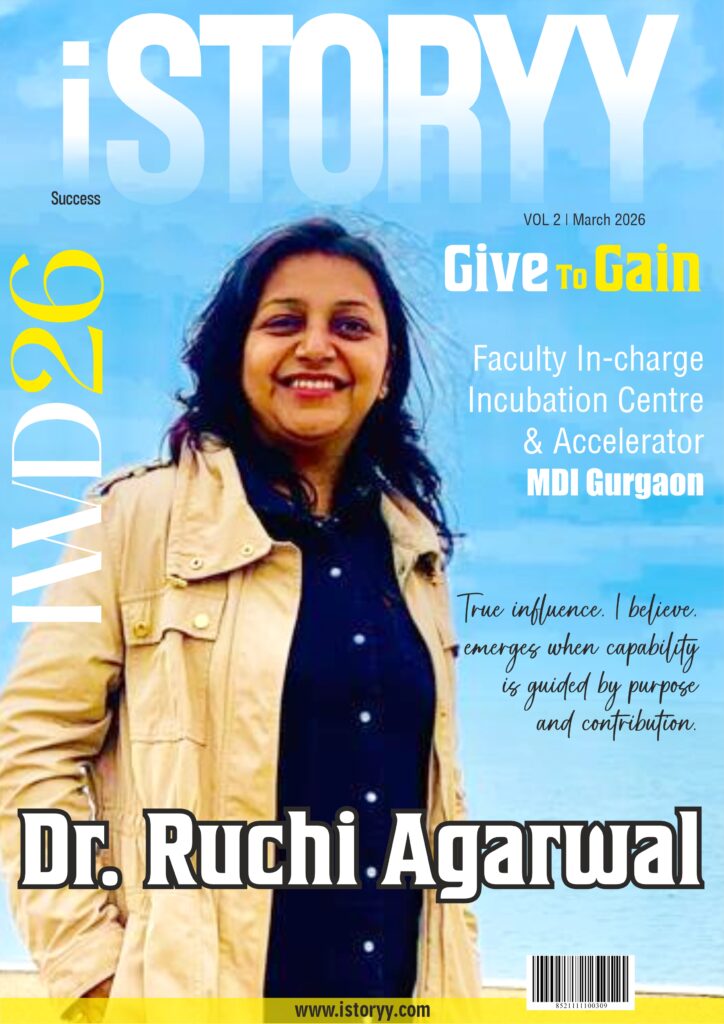
Dr Ruchi Agarwal
Faculty In-charge – Incubation Centre & Accelerator
MDI Gurgaon
Q1. What first drew you toward academia, and how did that
calling shape your professional journey?
My transition into academia was not pre-planned; it evolved naturally from curiosity. I began my career as a well-compensated Insurance and Risk professional, yet I remained deeply drawn to learning, often spending weekends in libraries even after marriage. Co-authoring a book with the director of a reputed institute proved transformative. It uncovered my enduring passion for Strategy and Risk Management. I always felt that I can do better if structurally learn. That experience ultimately set me on the path toward research and a PhD.
Q2. What inspired you to start your journey, and how has
that purpose evolved over time?
My greatest source of inspiration is my husband, who encouraged me to look beyond comfort zones and pursue global standards of excellence. From the outset, discipline and a deep passion for the fields of risk and insurance became my anchor, as passion is the force that sustains one through every challenge. Pursuing a PhD while raising two young children required unwavering commitment, and earning distinction strengthened my resolve. Equally influential was my mother’s enduring belief that her daughter would achieve what she herself could not, despite being capable. What began as personal ambition gradually evolved into a broader purpose: contributing meaningfully to research, education, and institutional development.
Q3. What was the toughest challenge in your early days, and
what did it teach you about leadership and resilience?
Balancing doctoral research with motherhood was undoubtedly my greatest challenge. Without discipline and strong passion, it was not possible. A defining moment came in the third year of my PhD when I received an external offer for a highly paid position, leaving me genuinely conflicted. My PhD director posed a simple yet profound question: if you leave your PhD, can you return to it later; if you decline the job, might another opportunity arise? That reflection reaffirmed my decision, reminding me that passion gives resilience its strength and direction, while leadership begins with choosing long-term purpose over short-term certainty.
Q4. As a woman entrepreneur, what unique strengths do
you believe you bring to building and leading a venture?
As a woman entrepreneur, I believe my key strengths are discipline, determination, and strong stakeholder management. These qualities help me stay focused on long- term goals and work consistently toward achieving them. Women often learn to balance multiple responsibilities, such as family and career. This experience builds resilience and the ability to manage time, resources, and expectations effectively—even in challenging situations. Because of this, I remain determined and committed even when resources are limited or when the path to success is uncertain. Another important strength is stakeholder management. Women are often skilled at understanding different perspectives and maintaining relationships with employees, customers, partners, and investors. By combining empathy with structured decision-making, we can create trust, encourage collaboration, and build strong teams. These abilities help in creating ventures that are resilient, sustainable, and people-oriented, which are essential for long- term success. As Indra Nooyi once said: “Leadership is hard to define, and good leadership even harder. But if you can get people to follow you to the ends of the earth, you are a great leader.” This belief inspires me to lead with purpose, responsibility, and strong relationships, which are essential in building a successful venture.
Q5. Have you ever faced self-doubt, and what mindset or
support system helped you move forward?
Yes, I have experienced moments of self-doubt, especially recently when I faced two major challenges—one related to my health and the other related to my career. On the health side, I suddenly developed allergies to multivitamins and paracetamol. This led to low vitamin levels and hormonal imbalance, which caused my weight to increase by almost 10 kilograms in a year and also reduced my physical strength. It was a difficult phase. Many people around me suggested easier options like strict dieting or medical procedures. However, I decided to take a long-term and sustainable approach. I hired a fitness trainer, started going to the gym regularly, and focused on gradually reducing weight while building strength. This decision required patience and discipline, but it helped me regain both physical confidence and mental resilience. A similar mindset guides my career decisions. I have seen many colleagues choose shortcuts or quick outcomes in research to gain faster promotions. However, I strongly believe in the concept of Prof Peter Senge’s idea of Double- Loop Learning rather than Single-Loop Learning. Instead of focusing only on immediate results, I prefer to question assumptions, learn deeply, and build knowledge that creates long-term impact. I also follow a simple principle: taking ten initiatives in one direction is more powerful than taking ten initiatives in ten different directions. Consistency and clarity of purpose help create meaningful progress. The support of friends, colleagues, and mentors, along with a mindset focused on long-term growth, discipline, and resilience, has helped me move forward even during challenging times. As Thomas Edison once said: Our greatest weakness lies in giving up. The most certain way to succeed is always to try just one more time.
Q6. How do you balance ambition with personal well-being
while sustaining long-term growth?
For me, maintaining work–life balance is very important for long-term success. I believe that personal well-being and professional ambition should grow together, not compete with each other. I often reflect on insights from the Harvard Study of Adult Development, which shows that people feel happier when they learn new skills, travel and gain new experiences, and see their loved ones happy. These factors help maintain both motivation and emotional well-being. In my view, a person may grow faster when focusing only on individual success. However, sustainable growth happens when the people around us—family, colleagues, and teams—also grow and feel fulfilled. When everyone progresses together, the journey becomes more meaningful and stable. I believe the same idea applies to organizations as well. When leaders focus not only on results but also on the growth and well-being of their teams, the organization becomes stronger and more sustainable in the long run.
Q7. What does “Give to Gain” mean to you in the context of
leadership, business, and impact?
To me, “Give to Gain” reflects the enduring principle that meaningful contribution precedes lasting success. It is about sharing knowledge, enabling others, and creating value that extends beyond individual achievement. During my PhD, my supervisor offered a perspective that stayed with me: becoming a subject matter expert is not extraordinary—what truly matters is how your work creates impact for society. That insight reshaped my understanding of leadership and research alike. True influence, I believe, emerges when capability is guided by purpose and contribution.
Q8. Can you share one mistake that became a defining
lesson in your journey?
It is difficult to isolate a single mistake, because in research and innovation, setbacks are inseparable from progress. I strongly believe that failure is not a deviation from success, but an integral part of it. Many ideas will not work, and that is perfectly acceptable—it signals experimentation and learning. In environments where risk-taking is often avoided, I see mistakes as evidence of courage and innovation. Without taking risks, one rarely discovers new opportunities or meaningful breakthroughs.
Q9. What strategies do you use to build, inspire, and retain
a strong, aligned team?
Building and sustaining a strong team, in my experience, relies heavily on negotiation, counselling, and the art of listening. These principles are universal—they work as
effectively with teenagers as with professionals at any stage of their careers. I believe a good leader must first be a patient listener, creating space for dialogue and mutual understanding. Equally important is emotional regulation; when tensions rise, stepping away briefly can prevent reactive decisions. Finally, I emphasize proactive structuring—dividing work into clear daily routines fosters clarity, accountability, and sustained alignment.
Q10. What advice would you offer to young women who
want to start their own venture but feel hesitant?
Feeling hesitant before starting a venture is completely natural, especially because many people worry about financial security and stability. However, if hesitation continues for too long, it can become the biggest barrier to growth. One important thing to remember is that confidence does not usually come before action—it develops through action. When you start, experiment, and learn from experiences, your confidence gradually grows. Every small step forward helps build clarity and courage. It is also important to recognize the value of support systems. Behind many successful women entrepreneurs, there is often a supportive family environment. Sometimes it is a partner who may be busy with their own work but still respects, trusts, and encourages their ambition. So my advice to young women is simple: start small, keep learning, and believe in your journey. Progress may be gradual, but taking the first step is what truly creates opportunities for success.
Q11. In one powerful sentence, how would you define
success today?
Success, to me, is the ability to recognize and act upon opportunities unseen by others, guided by passion, discipline, and the capability to create lasting impact.